
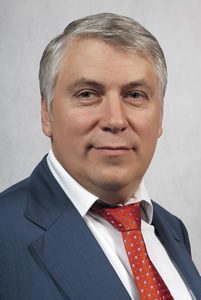
 Griazev Mikhail Vasilievich began his career in 1978 while studying at the university as a laboratory assistant of ONIL-8 of the Tula Polytechnic Institute. After graduating from the graduate school and defending his Ph.D. thesis he worked as a junior research fellow of the research part of TulPI.
Since 1988, he worked at the Department of Computational Mathematics, later renamed the Department of Mathematical Modeling, first as an assistant, then as an assistant professor. In 2002 he defended his doctoral dissertation. Since September 2004 he worked as a professor at the Department of Physical Education and Sport of the Tula State University and acted as the head of the department.
As part of the educational work, he organized the formation of a number of new academic disciplines, postgraduate students and applicants for academic degrees are being trained, the volume of the established training load is annually fulfilled.
As part of the teaching and methodological work of prof. Gryazev M.V. coordinated the work of the staff of the department to provide new courses with a full range of methodological support, organized work on the pre-university preparation of future applicants.
In the field of scientific research, M.Gryazev. a lot of work is being done to implement a number of directions of federal and sectoral scientific research programs that he heads. Scientific activity M.V. Gryazev is devoted to modeling complex systems. There are three main periods in it: work at the Faculty of Automated Control Systems under the guidance of B.М. Podchufarova, preparation and defense of the doctoral thesis at the Department of Computational Mathematics (Mathematical Modeling) and work at the Department of FViS.
The first period is completely devoted to the development of a controlled system of a gas-dynamic experiment in modeling the flow past bodies with a supersonic flow with a purposeful change in the properties of the latter. With the direct participation of M.V. Griazev developed theoretical foundations for such an experiment. The results of theoretical studies served as the basis for a number of inventions. The main achievement of this period was the creation of an original shock-type wind tunnel that operates on compressed air and allows experiments on flow around small objects – bullets of small arms and shells of small-caliber automatic cannons. Based on these studies, MV. Griazev defended his thesis for the degree of candidate of technical sciences.
During the second period of MV. Griazev studied the interaction of a deformed drummer with a barrier of a complex structure. This direction is directly related to the increase in the effectiveness of ammunition, focused on the defeat of the body, protected by special means – bulletproof vests, helmets, etc. Thereby M.V. Gryazev realized the transition from the study of purely technical systems to biotechnical ones.
The methodological foundations of the research, outlined in his works, made it possible to link the characteristics of the movement of the ammunition to the target, the mechanical properties of its elements, the protective agent and the properties of the biomaterials of the protected organism. The application of the achieved results in the practice of the PCU (Tula) led to the creation of a new, highly effective bullet for the Makarov pistol adopted by the Russian Army. At the same time, it was established that to study the stopping action of an ammunition, it is necessary to develop a model of the organism as a complex biological system governed by the signals of the central nervous system, and also to study the properties of biomaterials of a living organism.
In the third stage, M.V. Gryazev headed a group of staff of the departments of mathematical modeling and FViS, engaged in modeling the controlled and passive movements of the human body. The basis of the model is a system of curvilinear rods and three-dimensional bodies representing the bones of the skeleton. The joints of the bones are modeled by nonideal hinges, and the “drives” that provide controlled motion are skeletal muscles. In his works, the mathematical foundations of modeling a deformable skeleton are presented and aspects of the application of the mathematical model in the analysis of emergency situations (in the passive mode) and in sports (in the active mode) are reflected. A technique for determining the characteristics of skeletal muscles in vivo is proposed by analyzing the results of exercises on special simulators.
Immediate efforts of M.V. Gryazev allowed to expand the scientific relations of the department with the leading universities and scientific centers of the country, as well as to establish cooperation with leading scientists in the field of ammunition and biomechanics. In total, M.V. Gryazev has 7 copyright certificates in the field of defense technology and 55 scientific papers, 2 monographs and a number of methodological manuals.